
If You Leave, I'll Cut You Off: What That Threat Really Means
Sep 16, 2026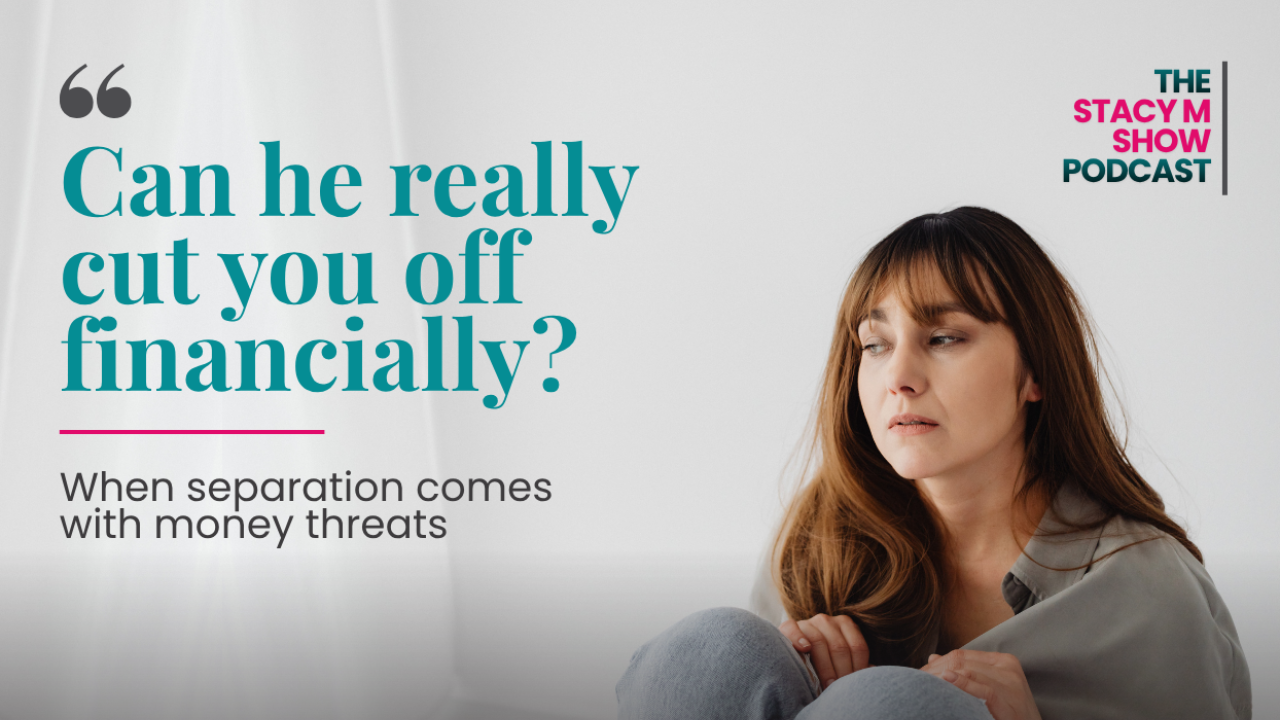
A woman messaged me after a webinar last month. She was not asking about parenting schedules or who gets the house. She wanted to know one thing: could her husband actually cut her off completely if she left.
That question has stuck with me. Because I hear some version of it more than you would think, and every time, it comes from someone who sounds smaller than they should. Someone whose voice has quietly shrunk down to fit inside a threat.
"If you move out, I'll cut you off completely."
If you have heard those words, or something close to them, I want you to keep reading. Not because I have a magic fix, I do not. But because there is a difference between what that threat feels like and what it actually means, and once you see that difference, things start to look a little less impossible.
It's Rarely As Simple As It Sounds
Here is something I think gets missed a lot. When someone threatens to cut you off financially, it is not always coming from the same place.
Sometimes it is fear. Genuine, messy, panicked fear. Someone who has just heard the word separation for the first time and their brain has gone straight into survival mode. People do not always say sensible things when they are terrified. They say the thing that feels like it might make the fear stop, even if that thing is cruel.
And sometimes it is control. Calm, calculated, deliberate. Money used as a tool because it has worked before. This version does not panic. It plans.
Knowing which one you are dealing with matters, because your response should not be the same for both.
Fear Looks Like This
Fear-based reactions tend to show up suddenly, right when separation first comes up. There is crying. Pleading. Desperation. You might hear "I can't live without you" or "I don't know what I'll do." There might even be promises to change, to go to counselling, to fix everything overnight.
It is not comfortable to sit with, but it is human.
Control Looks Like This
Control is different. It has usually been there all along, just wearing different outfits depending on the season of the relationship. It gets delivered calmly, almost like a business transaction, with specific details about exactly how your life is about to get harder. And sometimes, underneath it, there is a flicker of satisfaction. A sense of enjoying the power.
If that is what you are looking at, this is not fear talking. This is a pattern.
The Part I Need You To Hear
Whichever one it is, here is the truth that does not change: your legal rights do not disappear because someone says they will.
Your entitlement to a fair settlement, to support, to a life that is not dictated by fear, does not vanish because your name is not on the account. The family court does not run on threats. It runs on facts, and facts can be documented.
So start documenting. Every account, every asset, every debt. Take photos. Make copies. Do it quietly if you need to, so nothing gets triggered before you are ready.
If it is safe, open your own account. It does not need to start big. Twenty dollars is still a start.
And talk to a lawyer sooner rather than later. So many offer a free first consultation, and that conversation alone can take an enormous weight off your shoulders, just from finally knowing where you actually stand.
What To Actually Say
If it feels like fear, try meeting it with steadiness rather than a fight. Something like, "I understand you're scared, I'm scared too, but we need to figure out how to do this fairly for both of us." Then hold your line gently. "I hear that you're frightened, but threatening me isn't going to change my mind about needing space."
If it feels like control, the approach needs to shift. This is where the grey rock method comes in, keeping things boring, factual, unreactive. Document what is said. Get legal advice early. And do not give advance warning before you are ready, especially when it comes to important documents, passports, and anything else you might need later.
The Quiet Belief Underneath It All
Here is something I see constantly with the people I work with. It is rarely just about the threat itself. It is about an old belief that got planted somewhere along the way, that you are not capable of managing money on your own, or that financial security only exists because of someone else.
That belief can trap you just as effectively as any threat.
So let me say this plainly. You are more capable than you have been led to believe. Thousands of people start over financially every single day, and they do not just get by, they build something better than what they had. Your worth was never sitting in a bank balance.
A Word For The Person Making The Threats
If you are the one saying these things because you are scared, I understand where that comes from, even though it does not make it okay. But threatening someone financially will not make them stay. It tends to do the opposite, and it often builds resentment that outlasts the relationship itself. Try this instead. "I'm really scared about how we'll both manage financially. Can we work together to figure this out?" Counselling, individual or as a couple, can help with the fear that is really driving the threat.
Before You Go
Whether what you are facing comes from fear or from control, you still deserve to feel safe. You still have rights. You still deserve respect. If money is being used to control you, that is not love, that is manipulation. And if it is fear driving the threats, that person needs support to process it in a healthier way, but that support is not your job to provide at the cost of your own wellbeing.
If you are living this right now, here is where I would start. Book a consultation with a family lawyer. Look into what support you might be entitled to. Consider talking to someone about the emotional weight of it, because that part deserves attention too.
What would it look like for you to take just one quiet, protective step this week?
Separation is hard enough without financial threats piled on top of it. You are allowed to make decisions based on what is right for you, not based on fear of what someone else might do.
If this reached you at the right time, or you know someone who needs to hear it, share it with them. And if you are ready for real support through this, my Empowered Separation program was built for exactly this moment, with a few different ways in depending on where you are starting from.
You can also catch the full conversation on the podcast, wherever you listen.
Don’t miss out on powerful conversations every week! Join us for fresh episodes that dive deep into relationships, personal growth, and resilience. Hit subscribe and tune in to The StacyM Show—your journey to a stronger, more empowered life starts here!